

DECEMBER LEGAL UPDATE 2020
FUTURE COMPLIANCE DATES
DECEMBER 31, 2020 (if on a calendar year plan): 401(k), 125 POP & FSA Testing
Employers who offer a 401(k) plan, 125 Premium Only Plan, or Flexible Spending Account must conduct nondiscrimination testing as of the last day of their plan year to ensure that benefits are available to all eligible employees under the same terms. For calendar-year plans, testing must be completed by December 31.
JANUARY 1, 2021: IRS Limits Increases
Effective January 1, 2021, the Internal Revenue Service and Social Security Administration made a number of cost-of-living adjustments applicable to dollar limitations for qualified retirement plans, benefit plans, and other limits for the tax year 2021. See below for a recap of the adjustments. Employers should make adjustments to their payroll systems of any applicable changes and notify employees.
FEBRUARY 1, 2021: Forms W-2 and 1099 (when applicable) Due
Employers must provide all employees copies of Form W-2 reporting earnings and taxes for 2020 by February 1, 2021. When applicable, employers must provide Forms 1099 to contractors who earned more than $600 in business-related payments in 2020.
FEBRUARY 1, 2021: Post OSHA Form 300A
Employers with more than 10 employees who are not in exempted low-risk industries must post Form 300A, the annual summary of job-related injuries and illnesses, in a workplace common area from February 1 through April 30, 2021. If there were no recordable injuries or illnesses, applicable companies must still post the form with zeroes on the appropriate lines. See a list of exempted industries here: Partially Exempt Industries.
FEBRUARY 1, 2021: Form 941 Due
Form 941, the employer’s quarterly tax return, is due February 1 for the fourth quarter of 2020. Click here to access Form 941. Credit for FFCRA-qualified paid sick leave wages and qualified paid family leave wages can be requested on this form. Employers may also opt to use Form 7200 to request an advance payment of the tax credits for qualified sick and qualified family leave wages and the employee retention credit that will be claimed on Form 941.
FEDERAL COMPLIANCE UPDATES
NEW COVID LEGISLATION SIGNED
President Donald Trump signed the new coronavirus relief package into law on Sunday, December 27, 2020. The law contains over 5,500 pages detailing the relief package and other provisions. Here is a summary of key elements for employers to note. As with the COVID-19 legislation passed earlier this year, we can anticipate updates from the U.S. Department of Labor and the U.S. Department of Treasury providing clarification and guidance in coming days.
$600 Stimulus Checks
Taxpayers earning less than $75,000 / $150,000 for joint filers (based on reported 2019 income) will receive a check for $600 ($1200 for married taxpayers who file jointly) and an additional $600 per qualifying child age 16 or younger.
Paid Sick Leave and Expanded FMLA Tax Credits Extended
The December 31, 2020 deadline still stands for mandated paid sick leave and expanded FMLA related to COVID-19. However, FFCRA payroll tax credits for paid sick and family medical leave are now voluntarily extended through March 2021. As such, employers now have the option to grant or deny Emergency Paid Sick Leave and/or Expanded Family Medical Leave. Payment for leave taken on or before December 31, 2020 remains mandatory. Any paid time so granted after December 31, 2020, will be eligible for payroll tax credits through March 31, 2021.
PPP Loans
More than $284 billion in additional funds is available for first and second forgivable loans through the Paycheck Protection Program (“PPP”). The revised criteria for a new PPP loan are:
- Not more than 300 employees
- Has used or will use the full amount of first PPP loans
- Had gross receipts during the first, second, third, or fourth quarter in 2020 that demonstrate a reduction of 25% or more from the gross receipts of the business during the same quarter in 2019.
Additional eligible expenses qualifying for PPP Forgiveness are extended to include most but not all operational expenses, property damage, supplier costs, and purchases of Personal Protective Equipment (PPE).
Borrowers may select to use any period from 8 weeks to 24 weeks as their “covered PPP Loan period”.
A new simplified Loan Forgiveness form will be issued by the Small Business Administration for borrowers whose loan was under $150,000.
PPP Loans may now be applied for and approved through March 31, 2021.
EIDL Loans
Advances received for the Emergency Income Disaster Loan (EIDL) are deemed non-taxable income.
The EIDL Program has been granted an additional $20 billion in funding, with a directive to distribute money to low-income areas first, based on ZIP code.
FSA Plans
Health and Dependent Care FSA Plans may now permit unused benefits from the 2020 plan year to be carried over to the next tax year, through the 2021 Plan Year.
Medicare fees are temporarily increased by 3.75% to help offset lost revenues for healthcare providers.
Payroll Tax Credits
Payroll tax deferrals which were slated to end December 31, 2020, may now be deferred until December 31, 2021, with no penalties or interest accruing until January 1, 2022.
Provider Relief Fund
$3 billion has been allocated to the HHS Provider Relief Fund to assist medical facilities who have lost revenue due to COVID-19 or who have been directly involved in COVID-19 response activity.
Unemployment Supplemental Payments
Pandemic Unemployment Assistance payments of an additional $300/week are authorized through March 14, 2021. Because most states (except New York) calculate their Unemployment Benefits from Sunday to Saturday, and the President did not sign the legislation until a Sunday, it is presumed that the $300 supplements will not be paid for the week of December 19 to 26, except in New York. It is also widely expected that there will be a break in payment of benefits because the states need to reprogram their computers to allow for distributing the additional money. However, if such a break occurs, this money is expected to be paid retroactively to January 3, 2021.
Other Provisions
100% of business meals in 2021 and 2022 may be written off, provided the food and beverage is from a restaurant or bar and was paid before January 1, 2023.
Taxpayers may claim $300 / $600 married filing jointly in above-the-line charitable deductions for cash payments to established charities in 2021.
Click here for the 2021 Compliance Calendar
EEOC SAYS EMPLOYERS CAN REQUIRE PROOF OF COVID – 19 VACCINATION
The EEOC has issued guidance that says that employers who require their employees to receive COVID-19 vaccinations can require proof that employees have received the vaccine. Employers must show that the requirement is job-related and consistent with business necessity.
The guidance also listed exceptions from such requirements. In the event that an employee is unable to receive a vaccine due to a disability or religious belief, the employer should conduct an individualized assessment to determine whether a direct threat scenario exists. If a direct threat cannot be reduced to an acceptable level through a reasonable accommodation, the EEOC guidance stated that the employer may exclude the employee from physically entering the workplace.
REMINDER OF INCREASED 2021 IRS LIMITS
Effective January 1, 2021, the maximum earnings subject to the Social Security payroll tax will increase by $5,100 to $142,800.
Below is a recap of the 2021 annual limits for qualified retirement plans.
|
Defined Contribution Plan Limits |
2021 |
|
Maximum employee elective deferral (age 49 or younger) |
$19,500 |
|
Employee catch-up contribution (age 50 or older)* |
$6,500 |
|
Maximum employee elective deferral plus catch-up contribution (age 50 or older) |
$26,000 |
|
Defined contribution maximum limit, employee + employer (age 49 or younger)** |
$58,000 |
|
Defined contribution maximum limit (age 50 or older); maximum contribution all sources + catch-up |
$64,500 |
|
Employee compensation limit for calculating contributions |
$290,000 |
|
Key employees’ compensation threshold for nondiscrimination testing |
$185,000 |
|
Highly compensated employee (HCE) threshold for nondiscrimination testing |
$130,000 |
*The $6,500 catch-up contribution limit for participants age 50 or older applies from the start of the year to those turning 50 at any time during the year.
**Total contributions from all sources may not exceed 100% of a participant’s compensation.
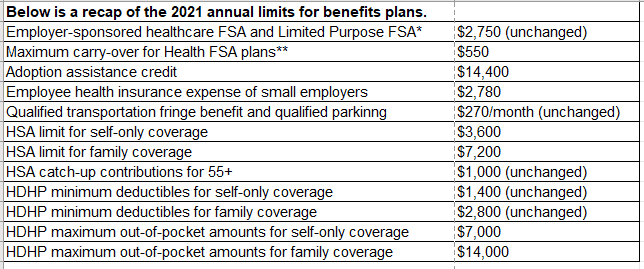
* While the IRS 2021 pre-tax maximum for employee health FSA contributions is $2,750, an employer may limit its employees to less than $2,750.
** Employers can adopt either the carry-over extension or the optional grace period extension of 2 ½ months.
REMINDER: IRS ALLOW Truncated SSNs on W-2s IN 2021
Effective January 1, 2021, employers will be permitted to truncate social security numbers on W-2s distributed to employees to help protect them from identity theft.
The Internal Revenue Service issued a final rule that will allow employers to replace the first five digits of Social Security numbers or alternative taxpayer identification numbers (TINs) with an asterisk (*) or “X” on Form W-2 wage and tax statements that are distributed to employees beginning in 2021.
Truncation is not mandatory. Employers who do opt-in will have the option to truncate for all their employee W-2s or to allow employees to make that decision for their own W-2.
REMINDER: Minimum Wage Increase for Federal Contractors
Effective January 1, 2021, the applicable minimum wage rate for workers performing work on or in connection with federal contracts covered by Executive Order 13658 will increase to $10.95 per hour. The required minimum cash wage that generally must be paid to tipped employees performing work on or in connection with covered contracts will increase to $7.65 per hour.
REMOTE FORM I-9 DOCUMENT REVIEW APPROVAL ONCE AGAIN EXTENDED
U.S. Immigration and Customs Enforcement (“ICE”) has once again extended the approval to remotely review an employee’s identity and employment authorization documents for Form I-9 but only when that employee will be working remotely. These provisions are now set to expire January 31, 2021.
Employers may first inspect Section 2 documents via video, fax, email, or other appropriate means. Once normal operations resume, employers must inspect documents in person and note “COVID-19” as the reason for the delay in the “additional information” field, as well as “documents physically examined” with the date of inspection to that field or Section 3 as appropriate. Alternatively, the form also allows an employer to appoint a representative to review new hires’ documents. Examples of such a representative include a law firm, a vendor, a notary, or a local employee. Please note that some states or local jurisdictions may have specific restrictions for who is authorized to review the employee documentation.
Employers who make use of the exception must provide written documentation of their remote onboarding and telework policy for each employee. They must also conduct in-person verification within three business days of when the employer’s normal operations resume. This date may be different (earlier or later) from the date the government policy ends.
OSHA RESOURCES RELATED TO COVID-19
OSHA has recently released new guidance and resources related to COVID-19, including:
- Lessons Learned: Frequently Cited Standards Related to COVID-19 Inspections
- Common COVID-19 Citations: Helping Employers Better Protect Workers and Comply with OSHA Regulations
- COVID-19 Guidance on Ventilation in the Workplace
PCORI FEE TO INCREASE IN 2021
The IRS is increasing the fee for the Patient-Centered Outcomes Research Institute (“PCORI”) that insurers or self-insured health plan sponsors must pay in 2021. The fee will be $2.66 per plan enrollee, up from $2.54 for the 2020 plan year. The annual fee must be paid to the IRS by July 31 for plan years ending between October 1, 2020, and October 1, 2021.
FINAL RULE EXPANDS RULES FOR GRANDFATHERED HEALTH PLAN STATUS
Under a new Final Rule published by the U.S. Departments of Labor, Health and Human Services, and Treasury, group health plans established before March 23, 2010 will be able to retain their grandfathered status to be exempted from certain requirements of the Affordable Care Act (“ACA”).
These plans are still subject to some of the ACA’s requirements, including prohibition on pre-existing condition exclusions, but they can be exempted from such ACA requirements as fully covering preventive care or imposing out-of-pocket spending limits for in-network care.
To remain grandfathered, these plans cannot significantly raise co-payment charges or deductibles or make other cost and coverage changes. However, grandfathered group health coverage offered through a high-deductible health plan (“HDHP”) may increase fixed-amount cost-sharing requirements such as co-payments, deductibles and out-of-pocket maximums to the extent necessary to maintain HDHP status without losing grandfathered status.
The new rule allows plan sponsors to make cost-sharing increases using either the consumer price index measure of medical inflation under final regulations issued in 2015 or the premium-adjustment percentage that HHS publishes in its annual notice of benefit and payment parameters, whichever is greater.
DOL CLARIFIES WHEN CONTINUING EDUCATION AND TRAVEL TIME ARE COMPENSABLE
The U.S. Department of Labor (“DOL”) has clarified the rules on when time spent fulfilling continuing-education requirements and when travel time of non-exempt foremen and laborers must be compensated under the Fair Labor Standards Act (“FLSA”).
In FLSA 2020-15, the DOL provides guidance on the compensability of employee training in six different scenarios. The new guidance confirms that when an employer allows an employee to fulfill continuing-education requirements during normal work hours, the time is compensable under the FLSA. The content of the continuing education must be directly related to the employee’s job for it to be applicable.
The DOL also published FLSA 2020-16, which provides three scenarios of when the travel time of non-exempt foremen and laborers is compensable. Whether the job site is local or involves significant travel time, the guidance clarifies that travel time between the employer’s principal place of business and the job site is compensable.
STATE COMPLIANCE UPDATES
ALASKA
Minimum Wage Increases
Effective January 1, 2021, the basic minimum wage in Alaska will increase to $10.34 per hour.
ARIZONA
REMINDER: Minimum Wage Increases
Effective January 1, 2021, the minimum wage in Arizona increases from $12.00 per hour to $12.15 per hour.
REMINDER: Flagstaff Minimum Wage Increases
Effective January 1, 2021, the minimum wage in Flagstaff increases to $15.00 per hour. This rate will supersede the state minimum wage rate.
CALIFORNIA
REMINDER: California Family Rights Act Expanded
Effective January 1, 2021, SB 1383 amends the California Family Rights Act (“CFRA”) to require California employers with five or more employees to provide family and medical leave rights to their employees. Previously, only employers with 50 or more employees were required to do so. The new law also expands the covered reasons for protected leave and the family members employees may take leave to care for under the law.
REMINDER: Paid Family Leave Also Expanded
Effective January 1, 2021, Paid Family Leave will expand by adding a new claim type called Military Assist. PFL Military Assist benefits will be available to eligible Californians who need time off work to participate in a qualifying event because of the military deployment of their spouse, registered domestic partner, parent, or child to a foreign country.
REMINDER: Family Leave Mediation Pilot Program Takes Effect
Effective January 1, 2021, employers with 5 to 19 employees that receive a right-to-sue-letter for alleged violations of the California Family Rights Act may request to participate in a mediation pilot program. An employee is not allowed to pursue a civil claim in court until the mediation is complete.
REMINDER: Kin Care Leave Law
Effective January 1, 2021, California’s Kin Care Leave Law is amended to prohibit an employer from designating sick leave for the employee’s own illness as kin care leave unless authorized by the employee. The Kin Care Leave Law allows employees to use half of their paid sick leave for the care of a family member.
REMINDER: Child Abuse and Neglect Reporting Act
Effective January 1, 2021, AB 1963 amends the California Child Abuse and Neglect Reporting Law to require that HR professionals for employers of at least five employees that includes minors, as well as adults who supervise minors, are considered “mandated reporters.” Failure to report known or reasonably suspected child abuse or neglect is punishable by up to 6 months in jail and/or a fine of up to $1,000.
REMINDER: Crime Victim Leave Law Amended
Effective January 1, 2021, AB 2992 amends California’s Crime Victim Leave Law to expand existing law providing protected leave for employees who are victims of domestic violence, sexual assault, or stalking, to now include leave for victims of other crimes or offenses that caused physical injury or that caused mental injury and a threat of physical injury. The amended law also provides protected leave for an employee whose immediate family member dies as a direct result of a crime and expands the types of documentation for leave eligibility that an employee may provide to verify that a crime or abuse occurred.
REMINDER: Minimum Wage Increases
Effective January 1, 2021, the state minimum wage will increase to $13.00 per hour for employers with 25 or fewer employees and to $14.00 per hour for employers with 26 or more employees. These rates may be superseded by a higher local rate.
Local minimum wage increases include the following:
- Belmont minimum wage will increase to $15.90
- Burlingame minimum wage will increase to $15.00
- Cupertino minimum wage will increase to $15.00
- Daly City minimum wage will increase to $15.00
- El Cerrito minimum wage will increase to $15.61
- Half Moon Bay minimum wage will increase to $15.00
- Hayward minimum wage will increase:
- 25 or fewer employees, will increase to $14.00
- 26 or more employees, will increase to $15.00
- Los Altos minimum wage will increase to $15.65
- Menlo Park minimum wage will increase to $15.25
- Mountain View minimum wage will increase to $16.30
- Novato minimum wage will increase:
- 25 or fewer employees, will increase to $14.00
- 26 or more employees, will increase to $15.00
- Oakland minimum wage will increase to $14.36
- Palo Alto minimum wage will increase to $15.65
- Petaluma minimum wage will be increased to $15.20
- Redwood City minimum wage will increase to $15.62
- Richmond minimum wage will increase to $15.21
- San Carlos minimum wage will increase to $15.24
- San Diego minimum wage will increase to $14.00
- San Jose minimum wage will increase to $15.45
- San Mateo minimum wage will increase to $15.62
- Santa Clara minimum wage will increase to $15.65
- Santa Rosa will increase to $15.20
- Sonoma minimum wage will increase:
- 25 or fewer employees, will increase to $14.00
- 26 or more employees, will increase to $15.00
- South San Francisco minimum wage will increase to $15.24
- Sunnyvale minimum wage will increase to $16.30
REMINDER: Minimum Pay for Exempt Computer Professionals, Physicians, and Surgeons Adjusted
Effective January 1, 2021, the minimum pay for overtime-exempt computer professionals and for physicians and surgeons paid an hourly rate in California increases under an annual inflation adjustment.
To be eligible for overtime exemption, computer professionals must be paid at least $98,907.70 on an annualized salary basis. That calculates to a minimum monthly salary of $8,242.32 or a minimum hourly rate of pay of $47.48.
To be eligible for overtime exemption, physicians and surgeons paid on an hourly basis increases from $84.79 to $86.49.
REMINDER: Anti-Harassment Training Deadline Still Set for January
California employers with five or more employees are required to provide one hour of training to non-supervisors and two hours of training to supervisors every two years. The training deadline for most employers is January 1, 2021, postponed from the original January 1, 2020 deadline. By 2021, new employees must be trained within six months of their hire date, and newly promoted supervisors must be trained within six months of their promotion. Employers who conducted compliance training in 2019 or 2020 are not required to provide retraining until two years after the previous training.
REMINDER: Notice and Reporting Requirements for Potential COVID-19 Exposure Enacted
Effective January 1, 2021, AB 685 expands the Cal/OSHA’s authority to issue Stop Work Orders for workplaces that pose a risk of an “imminent hazard” relating to COVID-19. California employers that receive a notice of potential exposure to COVID-19 must take all of the following actions within one business day of receiving the notice:
- Provide written notice to all employees and to the employers of subcontracted employees who were at the same worksite as an individual who has a laboratory-confirmed case of COVID-19 within the infectious period. Written notice may include, but is not limited to, personal service, e-mail, or text message if it can reasonably be anticipated to be received by the employee within one business day of sending and shall be in both English and the language understood by the majority of the employees.
- Provide written notice to the exclusive representative, if any, of affected employees.
- Provide all employees who may have been exposed and their exclusive representative, if any, with information regarding COVID-19-related benefits to which the employees may be entitled under applicable federal, state or local law; options for exposed employees; and anti-retaliation and anti-discrimination protections.
- Notify all employees, the employers of subcontracted employees, and their exclusive representative, if any, of the disinfection and safety plan that the employer plans to implement and complete per CDC guidelines.
Employers who are notified of an outbreak, as defined by the State Department of Public Health, have additional reporting obligations, including to report required information to the local public health agency in the jurisdiction of the worksite within 48 hours of learning of the outbreak.
In the event of any workplace COVID-19-related fatality, the employer must provide notification to the local health department of the name, number, occupation and worksite of any employee who died due to a COVID-19 exposure. An employer must also report the business address and North American Industry Classification System (“NAICS”) code of the worksite where the COVID-19-positive employee worked.
COLORADO
REMINDER: Healthy Families and Workplaces Act (“HFWA”); Notice Required
Effective January 1, 2021, Colorado employers with at least 16 employees must begin providing paid sick leave under the Healthy Families and Workplaces Act (SB20-205). Smaller employers under 16 employees will have to follow suit effective January 1, 2022. Employers will be required to provide employees with up to six days, or up to 48 hours, of earned paid sick leave each year.
REMINDER: Minimum Wage Increases
Effective January 1, 2021, the minimum wage in Colorado increases from $12.00 to $12.32 per hour. The minimum wage for tipped employees increases from $8.98 to $9.30.
REMINDER: Denver Minimum Wage Increases
Effective January 1, 2021, the minimum wage in Denver increases from $12.85 per hour to $14.77 per hour. The maximum tip credit is $3.02 per hour, so the minimum direct cash wage for food and beverage workers increases from $9.83 per hour to $11.75 per hour. These rates will supersede the state minimum wage rates.
CONNECTICUT
REMINDER: Connecticut Paid Family and Medical Leave
Effective January 1, 2021, employers must begin deducting 0.5% from every private employee’s paycheck to fund Connecticut Paid Family and Medical Leave. Employers are not required to contribute.
FLORIDA
REMINDER: Minimum Wage Increases
Effective January 1, 2021, the minimum wage in Florida increases to $8.65 per hour. The minimum wage for tipped employees increases from $5.63 per hour plus tips. Additional increases will occur every September through the year 2026.
ILLINOIS
Board Diversity Reporting Required
No later than January 1, 2021, applicable Illinois-based businesses will have to report to the state data on female and minority board membership.
HB 3394 requires publicly-traded businesses with principal executive offices in the state to report the number of women and minorities on boards, as well as their plans to promote diversity.
Final Part of Chicago’s Predictive Scheduling Law Takes Effect
Effective January 1, 2021, employees covered by the Chicago Fair Workweek Ordinance will have a private right of action against employers for violations of the ordinance. Employees are covered by the ordinance if they meet the following criteria:
- Make less than $26/hour or $50,000/year;
- Work in one of seven “covered” industries, including building services, healthcare, hotels, manufacturing, restaurants, retail, and warehouse services; and;
- The covered employer has at least 100 total employees
- For a restaurant, that threshold is 250 employees and 30 locations. While the ordinance took effect on July 1, 2020, the effective date for an employee’s private right of action was delayed in response to the COVID-19 pandemic.
While the ordinance took effect on July 1, 2020, the effective date for an employee’s private right of action was delayed in response to the COVID-19 pandemic.
The ordinance requires covered employers to provide:
- A good-faith estimate of days and hours of work to new hires;
- Advance notice of the work schedule to covered employees at least 10 days before the first day of the schedule;
- Compensation to covered employees for schedule changes made after the date on which the schedule must be posted; and
- Premium pay to covered employees if the employee works with fewer than 10 hours between shifts.
An employee may initiate a civil action with the Chicago Department of Business Affairs (“Department”) after:
- The employee submits a written complaint to the Department alleging a violation;
- The Department provides the employer with an opportunity to contest the alleged violation or cure the violation; and
- The Department has notified the complaining employee in writing that it considers the complaint to be closed, either because it has been cured, enforced, or deemed unjustified;
- Covered businesses must post a notice about the ordinance, available here: Fair Workweek Ordinance Notice.
REMINDER: Minimum Wage Increases
Effective January 1, 2021, the minimum wage in Illinois increases from $10.00 per hour to $11.00 per hour. The maximum tip credit increases from $4.00 per hour to $4.40 per hour.
The subminimum wage for minors increases from $8.00 per hour to $8.50 per hour.
MAINE
REMINDER: Minimum Wage Increases
Effective January 1, 2021, the minimum wage in Maine will increase to $12.15 per hour.
REMINDER: Mandated Paid Leave
Effective January 1, 2021, An Act Authorizing Earned Employee Leave (L.D. 369) requires employers with 10 or more employees for more than 120 days in a calendar year to provide one hour of paid leave for every 40 hours worked, up to a maximum of 40 hours of paid leave per year.
MARYLAND
REMINDER: Minimum Wage Increases
Effective January 1, 2021, the minimum wage for Maryland employers with 15 or more employees will increase to $11.75 per hour. The minimum wage for employees with fewer than 15 employees will increase to $11.60. Workers under the age of 18 must be paid at least 85% of the applicable minimum wage rate.
MASSACHUSETTS
REMINDER: Minimum Wage Increases
Effective January 1, 2021, the minimum wage in Massachusetts will increase to $13.50 per hour. The minimum wage for tipped employees will increase to $5.55.
REMINDER: Paid Family and Medical Leave
Effective January 1, 2021, Massachusetts employees will be entitled to begin taking leave accrued under the paid leave program funded by the payroll tax that went into effect July 1, 2019. Employers may take up to 12 weeks of paid leave to care for a family member or bond with a new child and up to 20 weeks of paid leave to address their own serious medical issues.
MISSOURI
Minimum Wage Increases
Effective January 1, 2021, the basic minimum wage in Missouri will increase to $10.30 per hour. The maximum tip credit will increase to $5.15 per hour.
MONTANA
Minimum Wage Increases
Effective January 1, 2021, the basic minimum wage in Montana will increase to $8.75 per hour.
NEW JERSEY
REMINDER: Minimum Wage Increases
Effective January 1, 2021, the minimum wage in New Jersey increases from $11.00 to $12.00 for employers with six or more employees and from $10.30 to $11.10 for employers with fewer than six employees and seasonal employers. The tip credit remains $7.87.
NEW MEXICO
Minimum Wage Increases
Effective January 1, 2021, the basic minimum wage in New Mexico will increase to $10.50 per hour. The maximum tip credit will increase to $7.95 per hour.
NEW YORK
REMINDER: Use of New York Paid Sick Leave Begins
Effective January 1, 2021, employees may begin using their accrued sick leave that began accruing under New York’s statewide paid sick leave law on September 30, 2020.
REMINDER: Paid Family Leave Benefits Increase
Effective January 1, 2021, employees will be eligible to receive 12 weeks of paid family leave (PFL) benefits during any 52-week calendar period at 67% of their average weekly wage or 67% of the state average weekly wage, whichever is less. This is an increase from previous levels of 10 weeks at 60%.
REMINDER: Increases to Minimum Wage
Effective December 31, 2020, the minimum wage rate for fast-food employees in New York increases to $14.50 per hour unless a higher rate is required by local ordinance. For example, the minimum wage for fast-food employees in New York City remains at $15.00 per hour.
Also effective December 31, 2020, the minimum wage for non-fast-food employees in Nassau, Suffolk and Westchester Counties increases to $14.00. The minimum wage for non-fast-food employees in all other parts of New York increases to $12.50.
In conjunction with the increases to minimum wage rates, the thresholds for administrative and executive exemptions from overtime pay also increase to $54,600 on an annualized basis for Nassau, Suffolk and Westchester counties, and to $48,750 on an annualized basis for all other areas in New York.
OHIO
Minimum Wage Increases
Effective January 1, 2021, the basic minimum wage in Ohio will increase to $8.80 per hour. The minimum cash wage for tipped employees increases to $4.40 per hour.
The minimum annual gross receipts threshold above which employers are subject to Ohio’s minimum wage law increases from $319,000 per year to $323,000 per year.
PENNSYLVANIA
Ruling on Marijuana Accommodations
In the case Harrisburg Area Cmty. Coll. v. Pa. Human Rels. Comm’n, the Pennsylvania Commonwealth Court has ruled that institutions of higher education are not required to accommodate the use of legally-prescribed medical marijuana. The court’s reasoning signals that employers also may not be required to accommodate an employee’s use of medical marijuana.
WASHINGTON
REMINDER: State Minimum Wage to Increase
Effective January 1, 2021, the minimum wage in Washington will be $13.69 per hour. Tips and service charges do not count toward the minimum wage payments.
Agriculture workers and farmworkers cannot be paid less than the minimum wage, even if they are normally paid on a piece-rate basis. There is a minimum wage exception for workers in Washington under age 16. Workers aged 14 or 15 can be paid 85% of the standard minimum wage, which is at least $11.64 per hour.
Due to the higher state minimum wage rate, salaried employees will have to meet a higher threshold in order to remain exempt from overtime payments. Employees at companies with 50 or fewer employees must earn a salary of at least $42,712.80 on an annualized basis, which is 1.5 times the minimum wage. Employees at companies with 51 or more employees must earn at least $49,831.60 on an annualized basis, which is 1.75 times the minimum wage. Computer professionals of employers with 50 or fewer employees must earn at least $37.65 per hour, or 2.75 the state’s minimum wage rate, to qualify for the computer professional exemption. Computer professionals of larger employers with more than 50 employees must earn at least $47.92 per hour, or 3.5 times the state’s minimum wage rate, to qualify for the applicable exemption.
REMINDER: Seattle Minimum Wage Increase
Effective January 1, 2021, the minimum wage for employees who work within the city limits of Seattle will increase to $16.69 per hour, with some exceptions. The minimum wage rate for employees in Seattle under 16 years old will be $14.19. For employers with 500 or fewer employees that contribute at least $1.69 per hour toward the employee’s medical benefits and/or where the employee earns at least $1.69/hour in tips, the minimum wage rate will be $15.00/hour. These rates will supersede the state minimum wage rates.
A new required posting notice can be downloaded here: Seattle Poster.
REMINDER: SeaTac Minimum Wage Increase
Effective January 1, 2021, the minimum wage for employees who work within the city limits of SeaTac will increase to $16.57 per hour for hospitality and transportation industry workers. This rate will supersede the state minimum wage rate.