

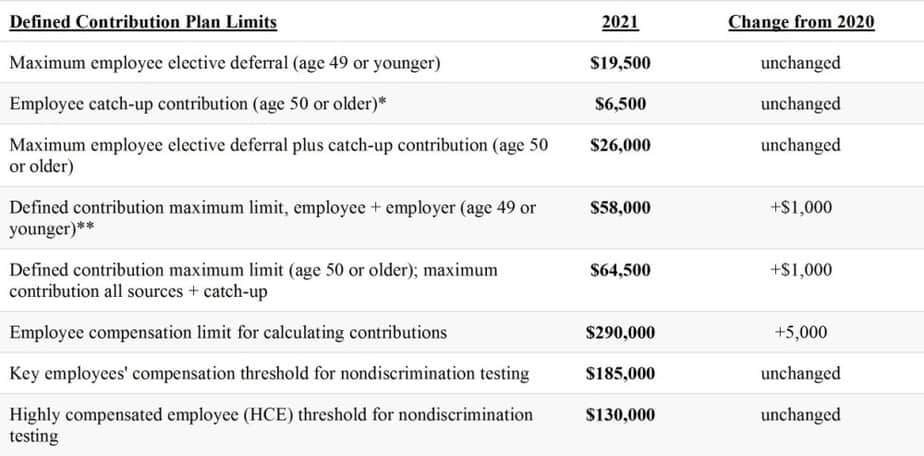
*The $6,500 catch-up contribution limit for participants age 50 or older applies from the start of the year to those turning 50 at any time during the year.
**Total contributions from all sources may not exceed 100% of a participant’s compensation.
Employers should update their plan designs for the new limits and make sure that their plan administration will be consistent with the new limits in 2021. Employers should also communicate all benefit plan limits to employees.
For more information, consult IRS Notice 2020-79.
2021 LIMITS FOR BENEFITS PLANS

* While the IRS 2021 pretax maximum for employee health FSA contributions is $2,750, an employer may limit its employees to less than $2,750.
** Employers can adopt either the carry-over extension or the optional grace period extension of 2 ½ months.
ADDITIONAL 2021 BENEFIT PLAN CHANGES AND CLARIFICATIONS
Drug Manufacturer Discounts May Be Excluded from Plan Limits
Effective January 1, 2021, self-funded group health plans will be permitted, but not required, to exclude the value of a drug manufacturer’s coupons and rebates from the annual limits on cost-sharing amounts (such as plan deductibles and out-of-pocket maximums). If excluded, these discounts would not count toward patient cost-sharing limits.
For additional details, see the Department of Health and Human Services’ Notice of Benefit and Payment Parameters for 2021 final rule and Fact Sheet.
Additional Information Regarding Employer Health FSA Contributions
If employers provide health care FSA contributions, this amount is in addition to the amount that employees can elect. Employees can elect up to the IRS limit and still receive the employer contribution in addition.
An employer may match up to $500 whether or not the employee contributes to a health FSA. Starting at $501, employers may only make a dollar-for-dollar match to the employee’s contribution.
2021 Limits on MSA and QSEHRA Plans and Long-Term Care Premiums
The deductible and out-of-pocket limits for “high deductible health plans” for Medical Savings Accounts are as follows:
- For self-only coverage, a health plan that has an annual deductible that is not less than $2,400 and not more than $3,600, and under which the annual out-of-pocket expenses required to be paid (other than for premiums) for covered benefits do not exceed $4,800.
- For family coverage, a health plan that has an annual deductible that is not less than $4,800 and not more than $7,150, and under which the annual out-of-pocket expenses required to be paid (other than for premiums) for covered benefits do not exceed $8,750.
The dollar total amount of payments and reimbursements for any year under a Qualified Small Employer Health Reimbursement Arrangement (“QSEHRA”) cannot exceed $5,300 ($10,700 for family coverage).
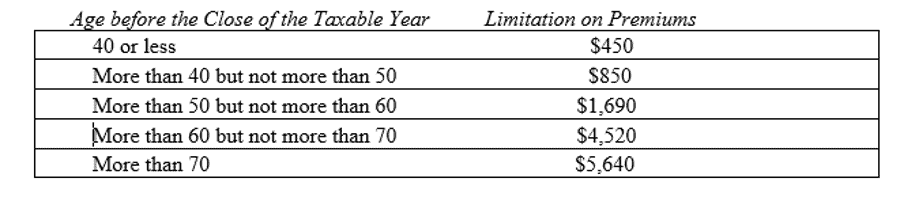
Eligible long-term care premiums are based on age and are subject to the following limits:
EBHRA Limits Remain Unchanged for 2021
The Internal Revenue Service announced the maximum amount allowed to be made available for Excepted Benefit Health Reimbursement Arrangements (“EBHRA”) for plan years beginning in 2021. At $1,800, the maximum EBHRA amount remains unchanged from 2020.
EBHRAs were created by the same final regulations that also introduced individual coverage HRAs. EBHRAs permit employers that offer a traditional group health plan to reimburse additional medical care expenses, such as to contribute toward copays, deductibles, or other expenses not covered by the primary plan, even if the employee declines enrollment in the traditional group health plan.
For additional information, see the full text at Revenue Procedure 2020-43.
NEW ACA AFFORDABILITY LIMITS FOR 2021
The 2021 ACA shared-responsibility affordability percentage increases to 9.83 percent of an employee’s household income, slightly up from 9.78 percent in 2020. This rate is the highest percentage of household income an employee can be required to pay for monthly plan premiums, based on the least-expensive employer-sponsored plan offered that meets the ACA’s minimum essential coverage requirements.
Since employers don’t likely know their workers’ household incomes, the ACA created three safe harbors, any of which can be used in place of household income:
- The employee’s W-2 wages as reported in box 1, generally as of the first day of the plan year.
- The employee’s rate of pay: an hourly wage rate multiplied by 130 hours per month or 9.83% of a monthly salary, as of the first day of the plan year.
- Using the federal poverty level (“FPL”) safe harbor, a monthly employee-only premium payment must be less than $104.53 per month.
DOL UPDATES MENTAL HEALTH PARITY COMPLIANCE TOOL
The Department of Labor (“DOL”) recently released an updated tool to help employers comply with the Mental Health Parity and Addiction Equity Act (“MHPAEA”) and related requirements under the Employee Retirement Income Security Act (“ERISA”).
MHPAEA applies to group health plans sponsored by private- and public-sector employers with more than 50 employees, including self-insured and fully insured arrangements.
The tool can be accessed here: MHPAEA Self-Compliance Tool.
NEW SUMMARY BENEFITS AND COVERAGE TEMPLATES
Effective for plan years beginning on or after January 1, 2021, plan sponsors must use the updated Summary of Benefits & Coverage (“SBC”) template and related materials available from the Departments of Labor and Health and Human Services when distributing the mandated SBC to individuals eligible for or enrolled in a health care plan.
The instructions for the SBC template have been updated to reflect standardized data provided by the Department of Health and Human Services. The Departments also released a new Coverage Example Calculator and instructions, along with a guide for each coverage example calculation scenario.
For complete details on the new SBC and its related materials, see SBC Guidance and Template.
IRS TO ALLOW TRUNCATED SOCIAL SECURITY NUMBERS ON W-2s IN 2021
Effective January 1, 2021, employers will be permitted to truncate social security numbers on W-2s distributed to employees to help protect them from identity theft.
The Internal Revenue Service issued a final rule that will allow employers to replace the first five digits Social Security numbers or alternative taxpayer identification numbers (TINs) with an asterisk (*) or “X” on Form W-2 wage and tax statements that are distributed to employees beginning in 2021.
Truncation is not mandatory. Employers who do opt in will have the option to truncate for all their employee W-2s or to allow employees to make that decision for their own W-2.
REMOTE FORM I-9 DOCUMENT REVIEW APPROVAL ONCE AGAIN EXTENDED
U.S. Immigration and Customs Enforcement (“ICE”) has once again extended the approval to remotely review an employee’s identity and employment authorization documents for Form I-9 but only when that employee will be working remotely. These provisions are now approved through December 31, 2020.
Employers may first inspect Section 2 documents via video, fax, email, or other appropriate means. Once normal operations resume, employers must inspect documents in person and note “COVID-19” as the reason for the delay in the section’s “additional information” field, as well as “documents physically examined” with the date of inspection to that field or Section 3 as appropriate. Alternatively, the form also allows an employer to appoint a representative to review new hires’ documents. Examples of such a representative include a law firm, a vendor, a notary, or a local employee. Please note that some states or local jurisdictions may have specific restrictions for who is authorized to review the employee documentation.
Employers who make use of the exception must provide written documentation of their remote onboarding and telework policy for each employee. They must also conduct in-person verification within three business days of when the employer’s normal operations resume.
GUIDANCE ON UPDATING I-9 FORMS FOR REMOTE HIRES
Immigration and Customs Enforcement (“ICE”) has released guidance for updating I-9 forms for hires made virtually during the coronavirus pandemic. The new guidance addresses the proper way to update the forms, including details on what to do if the employment authorization documents used during the virtual review have expired or are lost and if the person who originally examined the documents is not available to conduct the in-person physical inspection.
For additional details, see the DHS Guidance.
IRS GRADUALLY REDUCING E-FILING THRESHOLD
Effective January 1, 2021, the Taxpayer First Act reduces the threshold requirement for e-filing information returns such as Forms W-2, 1099 and 1095 from 250 or more forms to 100 or more forms. In 2022, the threshold will be further reduced to 10 or more forms.
MINIMUM WAGE INCREASE FOR FEDERAL CONTRACTORS
Effective January 1, 2021, the applicable minimum wage rate for workers performing work on or in connection with federal contracts covered by Executive Order 13658 will increase to $10.95 per hour. The required minimum cash wage that generally must be paid to tipped employees performing work on or in connection with covered contracts will increase to $7.65 per hour.
DOL FINALIZES RULES FOR POOLED RETIREMENT PLANS
Effective January 1, 2021, approved providers will be able to begin offering employers a new form of retirement plan called pooled employer plans (“PEPs”). PEPs differ from traditional defined contribution retirements plans, such as 401(k) plans, in that an employer that joins a PEP does not sponsor its own plan. The PEP plan provider assumes responsibility for administration, management and fiduciary responsibility for the plan. This could help employers mitigate risks, reduce administrative workload, and reduce fees.
For additional details, see the PEP Final Rule.
STATE COMPLIANCE UPDATES
ARIZONA
Recreational Marijuana Legalized
In November 2021, the “Smart and Safe Arizona Act” (Proposition 207) legalized marijuana for recreational purposes in Arizona. The Act will allow anyone over the age of 21 to legally possess up to one ounce of marijuana and amends criminal penalties for marijuana possession. The law also provides a process for individuals to seek expungement of previous marijuana-related convictions.
Sales of recreational marijuana could begin as early as March 2021, and adults will be able to legally grow as many as six marijuana plants for personal use.
Minimum Wage Increases
Effective January 1, 2021, the minimum wage in Arizona increases from $12.00 per hour to $12.15 per hour.
Flagstaff Minimum Wage Increases
Effective January 1, 2021, the minimum wage in Flagstaff increases to $15.00 per hour. This rate will supersede the state minimum wage rate.
CALIFORNIA
California Family Rights Act Expanded
Effective January 1, 2021, SB 1383 amends the California Family Rights Act (“CFRA”) to require California employers with five or more employees to provide family and medical leave rights to their employees. Previously, only employers with 50 or more employees were required to do so. The new law also expands the covered reasons for protected leave and the family members employees may take leave to care for under the law.
The amended CFRA requires that employers with five or more employees grant up to 12 weeks of unpaid, job-protected leave to eligible employees during any 12-month period for the purposes of bonding with a new child, caring for themselves or a family member, or for a qualifying exigency related to the covered active duty or call to covered active duty of an employee’s spouse, domestic partner, child, or parent in the military.
The employer must maintain and contribute to the employee’s coverage under a group health plan for the duration of the leave at the same level as though the employee had worked continuously for the duration of the leave.
To be eligible, an employee must have at least 1,250 hours of service with the employer during the past year. Employees must be allowed to keep any employer-paid health benefits during a qualified leave.
An employer that employs both parents of a child must grant up to 12 weeks of bonding leave to each employee, rather than a combined total of 12 weeks of leave under the previous law. The new law expands the list of family members for whom an employee may take leave, to include a child, parent, grandparent, grandchild, sibling, spouse, or domestic partner. It also removes the “key employee” reinstatement exception.
Paid Family Leave Also Expanded
Effective January 1, 2021, Paid Family Leave will expand by adding a new claim type called Military Assist. PFL Military Assist benefits will be available to eligible Californians who need time off work to participate in a qualifying event because of the military deployment of their spouse, registered domestic partner, parent, or child to a foreign country.
Family Leave Mediation Pilot Program Takes Effect
Effective January 1, 2021, employers with 5 to 19 employees that receive a right-to-sue-letter for alleged violations of the California Family Rights Act may request to participate in a mediation pilot program. An employee is not allowed to pursue a civil claim in court until the mediation is complete. The pilot program is scheduled to end January 1, 2024.
Kin Care Leave Law
Effective January 1, 2021, California’s Kin Care Leave Law is amended to prohibit an employer from designating sick leave for the employee’s own illness as kin care leave unless authorized by the employee. The Kin Care Leave Law allows employees to use half of their paid sick leave for the care of a family member.
Child Abuse and Neglect Reporting Act
Effective January 1, 2021, AB 1963 amends the California Child Abuse and Neglect Reporting Law to require that HR professionals for employers of at least five employees that includes minors, as well as adults who supervise minors, are considered “mandated reporters.” Failure to report known or reasonably suspected child abuse or neglect is punishable by up to 6 months in jail and / or fine of up to $1,000.
Employers subject to the law are required to provide training to employees who have reporting duties under the law. The training must include training in both the identification and reporting of child abuse and neglect. The training requirement may be met by completing the general online training for mandated reporters offered by the Office of Child Abuse Prevention in the State Department of Social Services.
Crime Victim Leave Law Amended
Effective January 1, 2021, AB 2992 amends California’s Crime Victim Leave Law to expand existing law providing protected leave for employees who are victims of domestic violence, sexual assault, or stalking, to now include leave for victims of other crimes or offenses that caused physical injury or that caused mental injury and a threat of physical injury. The amended law also provides protected leave for an employee whose immediate family member dies as a direct result of a crime and expands the types of documentation for leave eligibility that an employee may provide to verify that a crime or abuse occurred.
Minimum Wage Increases
Effective January 1, 2021, the state minimum wage will increase to $13 per hour for employers with 25 or fewer employees and to $14 per hour for employers with 26 or more employees. These rates may be superseded by a higher local rate.
Local minimum wage increases include the following:
- Belmont minimum wage will increase to $15.90
- Burlingame minimum wage will increase to $15.00
- Cupertino minimum wage will increase to $15.65
- Daly City minimum wage will increase to $15.00
- El Cerrito minimum wage will increase to $15.61
- Half Moon Bay minimum wage will increase to $15.00
- Hayward minimum wage will increase:
- 25 or fewer employees, will increase to $14.00
- 26 or more employees, will increase to $15.00
- Los Altos minimum wage will increase to $15.65
- Menlo Park minimum wage will increase to $15.25
- Mountain View minimum wage will increase to $16.30
- Novato minimum wage will increase:
- 25 or fewer employees, will increase to $14.00
- 26 or more employees, will increase to $15.00
- Oakland minimum wage will increase to $14.36
- Palo Alto minimum wage will increase to $15.65
- Petaluma minimum wage will be increased to $15.20
- Redwood City minimum wage will increase to $15.62
- Richmond minimum wage will increase to $15.21
- San Carlos minimum wage will increase to $15.24
- San Diego minimum wage will increase to $14.00
- San Jose minimum wage will increase to $15.45
- San Mateo minimum wage will increase to $15.62
- Santa Clara minimum wage will increase to $15.65
- Santa Rosa will increase to $15.20
- Sonoma minimum wage will increase:
- 25 or fewer employees, will increase to $14.00
- 26 or more employees, will increase to $15.00
- South San Francisco minimum wage will increase to $15.24
- Sunnyvale minimum wage will increase to $16.30
Overtime Exemption Changes for Agricultural Workers
The Phase-In Overtime for Agricultural Workers Act of 2016 (AB 1066) has been in effect since January 1, 2019, phasing in the elimination of the overtime exemption available for agricultural workers. Effective on January 1, 2021, agricultural workers of employers with 26 or more employees working more than 8 1/2 hours per day or in excess of 42.5 hours in any one workweek are to receive overtime pay at one-and-half times their regular rate of pay.
For employers with 25 or fewer employees, the phase-in schedule begins on January 1, 2022, through January 1, 2025.
Retaliation Protections Added
The minimum wage ordinances passed by the City of Half Moon Bay, Hayward, and San Carlos include retaliation protections that prohibit an employer from discharging, reducing the compensation or otherwise retaliating against any employee for engaging in a protected activity.
Minimum Pay for Exempt Computer Professionals, Physicians, and Surgeons Adjusted
Effective January 1, 2021, the minimum pay for overtime-exempt computer professionals and for physicians and surgeons paid an hourly rate in California increases under an annual inflation adjustment.
To be eligible for overtime exemption, computer professionals must be paid at least $98,907.70 on an annualized salary basis. That calculates to a minimum monthly salary of $8,242.32 or a minimum hourly rate of pay of $47.48.
To be eligible for overtime exemption, physicians and surgeons paid on an hourly basis increases from $84.79 to $86.49.
Rest Break Exemption for Private Security Officers Takes Effect
Effective January 1, 2021, certain private security officers can be required to remain on premises, remain on call, and carry and monitor a communication device during rest breaks.
To qualify for this exemption, a security officer must:
- be registered under the Private Security Services Act (“PSSA”);
- be employed by a private patrol operator registered under the PSSA; and
- be covered by a valid collective bargaining agreement that includes certain express provisions, including a regular hourly rate of pay at least a dollar more than the state minimum wage.
If a security officer’s rest period is interrupted, they must be allowed to restart the rest period as soon as practicable.
No-Rehire Exception in Settlement Agreements Expanded
Effective January 1, 2021, the exception to the prohibition against use of a no-rehire provision in an employment dispute settlement agreement with an employee who filed an official complaint will be expanded. The expanded exception includes instances when an employer, before the employee makes the complaint, has made and documented a good faith determination that the employee engaged in criminal conduct. This is in addition to existing exceptions that apply when an employee has been found to have engaged in sexual harassment or sexual assault.
Cal/OSHA Whistleblower Protections Provided to Domestic Workers
Effective January 1, 2021, AB 2658 expands the definition of “employee” to provide domestic work employees certain whistleblower protections. Specifically, the definition of employee now includes a domestic work employee, except for a person who performs household domestic service that is publicly funded. Domestic work employees are now protected against discharge or discrimination for refusing to perform work in violation of prescribed safety standards, where the violation would create a real and apparent hazard to the employee or fellow employees. In addition, domestic work employees have a right of action for wages for the time without work as a result of the layoff or discharge.
Human Trafficking Awareness Training Requirements for Transportation Employers
Effective January 1, 2021, AB 2034 requires that employers that operate intercity passenger rail or light rail stations and bus stations must provide training to employees who may interact with victims of human trafficking or are likely to receive a report regarding suspected human trafficking.
Cal/OSHA Amends Enforcement Procedures in Response to COVID-19
Effective January 1, 2021, Cal/OSHA modifies certain enforcement procedures in the event of a COVID-19-related exposure or serious violation. If Cal/OSHA suspends operations or restricts access to a worksite because it determines the risk of COVID-19 infection that would constitute an imminent hazard to employees, Cal/OSHA will send a notice to the employer that must be conspicuously posted by the employer in its workplace.
Cal/OSHA may also issue a citation alleging a serious violation without having to solicit information rebutting the presumption of a serious violation.
Anti-Harassment Training Deadline Still Set for January
California employers with five or more employees are required to provide one hour of training to non-supervisors and two hours of training to supervisors every two years. The training deadline for most employers is January 1, 2021, postponed from the original January 1, 2020 deadline. By 2021, new employees must be trained within six months of their hire date, and newly promoted supervisors must be trained within six months of their promotion. Employers who conducted compliant training in 2019 are not required to provide re-training until two years after the previous training.
California’s Department of Fair Employment and Housing (“DFEH”) has launched free online sexual-harassment-prevention programs that meet the training requirements for both supervisory and nonsupervisory employees in the state.
The training can be conducted live or online and must be conducted by an attorney or other qualified trainer who is knowledgeable about harassment, discrimination and retaliation prevention. Employers must keep training documentation for at least two years, and the documentation must include the names of the attendees who were trained, the training date, a sign-in sheet, a copy of all attendance or completion certificates issued, a description of the type of training provided, a copy of any written or recorded training materials, and the trainer’s name.
Information and links to training presentations can be found here: Harassment Prevention Training.
CCPA AND CPRA Expand Business Privacy Obligations
Previously scheduled to sunset on December 31, 2020, a majority of the rights applying to job applicants, employees and independent contractors and in the business-to-business context under the California Consumer Privacy Act (“CCPA”) has been extended until January 1, 2022.
Effective January 1, 2023, Proposition 24 — the California Privacy Rights Act of 2020 (“CPRA”) — will expand the CCPA. While most provisions of the CPRA go into effect in 2023, some provisions have a 12-month lookback.
Currently, the CCPA only applies to a business that meets any one of the following criteria:
- Has gross annual revenue in excess of $25 million;
- Annually receives, buys, sells or shares for commercial purposes the personal information of 50,000 or more California residents, households or devices; or
- Derives 50 percent or more of its annual revenue from selling personal information.
Under the new law, any employer or business that has an employee in California, accepts applications from California residents for positions anywhere in the nation, has customers in California who are natural persons, or otherwise does business in California (even if only over the internet) may be subject to the CCPA and CPRA. The CCPA may also apply to subsidiaries and franchisees if they meet a broad “control” test and share a common name or trademark with the covered business that controls them.
Retaliation Enforcement Amendments Take Effect
Effective January 1, 2021, AB 1947 extends the time to file a claim of retaliation and/or violations of the Labor Code from six months to one year after the occurrence of the violation. In addition, courts will be able to authorize reasonable attorney fees for a claimant who brings a successful action for a violation.
Notice and Reporting Requirements for Potential COVID-19 Exposure Enacted
Effective January 1, 2021, AB 685 expands the Cal/OSHA’s authority to issue Stop Work Orders for workplaces that pose a risk of an “imminent hazard” relating to COVID-19. California employers that receive a notice of potential exposure to COVID-19 must take all of the following actions within one business day of receiving the notice:
- Provide a written notice to all employees and to the employers of subcontracted employees who were at the same worksite as an individual who has a laboratory-confirmed case of COVID-19 within the infectious period. Written notice may include, but is not limited to, personal service, e-mail, or text message if it can reasonably be anticipated to be received by the employee within one business day of sending and shall be in both English and the language understood by the majority of the employees.
- Provide a written notice to the exclusive representative, if any, of affected employees.
- Provide all employees who may have been exposed and their exclusive representative, if any, with information regarding COVID-19-related benefits to which the employees may be entitled under applicable federal, state or local law; options for exposed employees; and anti-retaliation and antidiscrimination protections.
- Notify all employees, the employers of subcontracted employees, and their exclusive representative, if any, of the disinfection and safety plan that the employer plans to implement and complete per CDC guidelines.
Employers who are notified of an outbreak, as defined by the State Department of Public Health, have additional reporting obligations, including to report required information to the local public health agency in the jurisdiction of the worksite within 48 hours of learning of the outbreak.
In the event of any workplace COVID-19-related fatality, the employer must provide notification to the local health department of the name, number, occupation and worksite of any employee who died due to a COVID-19 exposure. An employer must also report the business address and North American Industry Classification System (“NAICS”) code of the worksite where the COVID-19-positive employee worked.
Illegal for California Employers to Direct Employees to Remain After Notice to Vacate
Beginning January 1, 2021, AB 2658 makes it a crime for a person, after receiving notice to evacuate or leave, to willfully and knowingly direct an employee to remain in, or enter, an area closed due to a menace to the public health or safety, such as the aftermath of a flood, storm, fire, earthquake, explosion, accident, or other disaster.
California Consumer Financial Protection Law Enacted
Effective January 1, 2021, the California Consumer Financial Protection Law (“CCFPL”), under A.B. 1864, creates a state version of the federal Consumer Financial Protection Bureau under the Department of Financial Protection and Innovation.
The CCFPL prohibits a covered person or service provider from:
- Engaging, having engaged, or proposing to engage in any unlawful, unfair, deceptive or abusive act or practice with respect to consumer financial products or services;
- Offering or providing to a consumer any financial product or service not in conformity with any consumer financial law or otherwise committing any act or omission in violation of a consumer financial law;
- Failing or refusing to do any of the following:
- Permitting the Department access to or copying of records;
- Establishing or maintaining required records;
- Making reports or providing information to the Department; or
- Knowingly or recklessly providing substantial assistance to a covered person or service provider in violation of the CCFPL or any rule or order issued under the CCFPL.
Employers Required to Provide Access to Injury and Illness Prevention Programs
As of January 1, 2021, employers must provide access to written injury and illness prevention program (“IIPP”) within five business days of an employee’s request. Employers must also provide notice of the right and procedure to access the IIPP to all employees.
Employers have two options to provide employees with access to their IIPP. They can provide a printed or electronic copy of the program, or they can allow employees unobstructed access through a company server or website that allows an employee to review, print, and email the current version of the IIPP.
Prop 22 Approval Classifies App-Based Drivers as Independent Contractors with Benefits
On November 5, 2020, California voters passed Proposition 22, which classifies app-based transportation and delivery company drivers as independent contractors instead of employees but creates a hybrid classification model that ensures certain benefits that typical independent contractors lack. App-based drivers will now be exempt from AB 5, which created a three-pronged test called the “ABC test,” to determine whether a worker should be classified as an employee or independent contractor.
Under Proposition 22, app-based drivers are entitled to receive the following benefits:
- Minimum net earnings of 120 percent of the state’s or locality’s minimum wage and 30 cents per mile;
- Driver gratuities cannot be deducted;
- Health care subsidies based on the average amount of time the driver spends driving via the platform, per week;
- Occupational accident insurance to cover drivers’ medical expenses or lost income resulting from injuries suffered while using the platform; and
- Accidental death insurance.
Under the measure, companies will have to develop anti-discrimination and sexual harassment policies and conduct local and national background screens. Drivers must complete a company-provided safety training and will be limited to working no more than a cumulative total of 12 hours during any 24-hour period unless the driver has logged off for an uninterrupted period of six hours.
App-based drivers were defined on the ballot as workers who:
- Provide delivery services on an on-demand basis through a business’s online-enabled application or platform, or
- Use a personal vehicle to provide prearranged transportation services for compensation through a business’s online-enabled application or platform.
San Francisco Hotel Worker Health and Safety Protections Take Effect
Effective November 9, 2020, tourist hotels and large commercial office buildings in San Francisco are required to comply with the San Francisco Healthy Buildings Ordinance. The Ordinance establishes cleaning and disease prevention standards and practices to help contain COVID-19 and other contagious public health threats.
The Ordinance also:
- Requires employers to train employees regarding these standards;
- Provides certain protections to employees who perform cleaning duties;
- Prohibits retaliation against employees who refuse to perform work under conditions they believe may be unsafe, or who report such conditions or exercise rights protected by the ordinance;
- Authorizes the Office of Labor Standards Enforcement to enforce the employee rights and protections under the Ordinance; and
- Requires the San Francisco Department of Public Health to administratively enforce the Ordinance; and
- Provides monetary penalties and civil actions as authorized by San Francisco and California law.
COLORADO
Equal Pay Law Expanded
Effective January 1, 2021, the Equal Pay for Equal Work Act amends the state equal pay law with the goal of ensuring that employees with similar job duties are paid the same wage rate, regardless of gender or another protected status.
Employers are required to make reasonable efforts to announce, post or otherwise make known all opportunities for promotion to all current employees on the same calendar day and before making a promotion decision. Promotion posting requirements do not apply to employees entirely outside of Colorado.
A “promotional opportunity” is defined as “a vacancy in an existing or new position that could be considered a promotion for one or more employee(s) in terms of compensation, benefits, status, duties, or access to further advancement.” Thus, it applies to any position regardless of level that would qualify as an advancement position for any employee. The regulations also specify that unless an exception applies, employers must notify all employees of promotional opportunities regardless of their qualifications but can set a qualification floor and screen applicants based on such qualifications. No promotion posting is required for confidential opportunities, where the employer has yet to inform the incumbent employees that they are being separated; automatic promotions after a trial period; or for positions to be filled on a temporary basis up to six months.
All postings for each job opening based in Colorado must include a general description of any bonuses, commissions, or other forms of compensation.
Under the Act, an employer is prohibited from:
- Seeking a prospective employee’s wage rate or relying on the prospect’s wage rate history to determine a wage rate;
- Discriminating or retaliating against a prospective employee who fails to disclose his or her wage rate history; or
- Discharging, discriminating or retaliating against a current employee who invokes the law on behalf of another or assists in its enforcement.
Differences in compensation can be based on a seniority system; a merit system; a system that measures earning by quantity or quality of production; the geographic location where the work is performed; education, training, or experience related to the work; or travel, if a regular and necessary condition of the work performed.
The new law also prohibits employers from preventing their employees from discussing their own compensation information with others and from requiring employees to sign a waiver that prohibits his or her ability to discuss compensation.
Healthy Families and Workplaces Act (“HFWA”); Notice Required
Effective January 1, 2021, Colorado employers with at least 16 employees must begin providing paid sick leave under the Healthy Families and Workplaces Act (SB20-205). Smaller employers under 16 employees will have to follow suit effective January 1. 2022. Employers will be required to provide employees with up to six days, or up to 48 hours, of earned paid sick leave each year.
Each employee earns at least one hour of paid sick leave for every 30 hours worked, up to 48 hours of paid sick leave per year, unless the employer selects a higher limit. Employees may carry over up to 48 hours of unused paid sick leave to the following year; however, employers can limit the amount of leave an employee may take in any year to 48 hours. Accrued paid sick leave is not required to be paid out at termination of employment. However, if an employer rehires a separated employee within six months of separation, the employer must reinstate any unused, accrued paid sick leave the employee had during the employee’s previous employment.
Employees may use accrued paid sick leave for the following reasons:
- The employee:
- Has a mental or physical illness, injury, or health condition that prevents the employee from working.
- Needs to obtain a medical diagnosis, care, or treatment of a mental or physical illness, injury, or health condition; or
- Needs to obtain preventive medical care.
- The employee needs to care for a family member who:
- Has a mental or physical illness, injury, or health condition;
- Needs to obtain a medical diagnosis, care, or treatment of a mental or physical illness, injury, or health condition; or
- Needs to obtain preventive medical care.
- The employee or the employee’s family member has been the victim of domestic abuse, sexual assault, or harassment and the use of leave is to:
- Seek medical attention for the employee or the employee’s family member to recover from a mental or physical illness, injury, or health condition caused by the domestic abuse, sexual assault, or harassment;
- Obtain services from a victim services organization;
- Obtain mental health or other counseling;
- Seek relocation due to the domestic abuse, sexual assault, or harassment; or
- Seek legal services, including preparation for or participation in a civil or criminal proceeding relating to or resulting from the domestic abuse, sexual assault, or harassment.
- Due to a public health emergency, a public official has ordered closure of:
- The employee’s place of business; or
- The school or place of care of the employee’s child and the employee needs to be absent from work to care for the employee’s child.
Employees must take paid sick leave in one-hour increments, unless the employer permits employees to take leave in smaller increments.
An employer may adopt a written policy that contains reasonable procedures for the employee to provide notice when the use of paid sick leave taken under the HFWA is foreseeable. If an employer already provides paid sick leave at the beginning of the year that meets or exceeds the requirements of the HFWA, additional accrued paid leave is not required.
In addition to the paid sick leave accrued as described above, employees are entitled to a one-time grant of leave in the event of a “public health emergency.” A public health emergency is defined as an act of bioterrorism, a pandemic influenza, or an epidemic caused by a novel and highly fatal infectious act for which a disaster emergency is declared by the governor or by a federal, state, or local public health agency.
Employers must supplement employees’ accrued, unused paid sick leave to total at least 80 hours for employees who work at least 40 hours a week and the average number of hours worked in two weeks for employees who work fewer than 40 hours a week, for the following public health emergency-related reasons:
- An employee’s need to:
- Self-isolate and care for oneself because the employee is diagnosed with a communicable illness that is the cause of a public health emergency;
- Self-isolate and care for oneself because the employee is experiencing symptoms of a communicable illness that is the cause of a public health emergency;
- Seek or obtain medical diagnosis, care, or treatment if experiencing symptoms of a communicable illness that is the cause of a public health emergency;
- Seek preventive care concerning a communicable illness that is the cause of a public health emergency; or
- Care for a family member who:
- Is self-isolating after being diagnosed with a communicable illness that is the cause of a public health emergency;
- Is self-isolating due to experiencing symptoms of a communicable illness that is the cause of a public health emergency;
- Needs medical diagnosis, care, or treatment if experiencing symptoms of a communicable illness that is the cause of a public health emergency; or
- Is seeking preventive care concerning a communicable illness that is the cause of a public health emergency;
- A local, state, or federal public official; health authority; or the employer determines that the employee’s presence on the job or in the community would jeopardize the health of others because of the employee’s exposure to the communicable illness or because the employee is exhibiting symptoms of the communicable illness, regardless of whether the employee has been diagnosed with the communicable illness;
- To care for a family member after a local, state, or federal public official; health authority; or the family member’s employer determines that the family member’s presence on the job or in the community would jeopardize the health of others because of the family member’s exposure to the communicable illness or because the family member is exhibiting symptoms of the communicable illness, regardless of whether the family member has been diagnosed with the communicable illness;
- To care for a child or other family member when the individual’s child care provider is unavailable due to a public health emergency, or if the child’s or family member’s school or place of care has been closed by a local, state, or federal public official or at the discretion of the school or place of care due to a public health emergency, including if a school or place of care is physically closed but providing instruction remotely;
- An employee is unable to work because of a health condition that may increase susceptibility to or risk of a communicable illness that is the cause of the public health emergency.
Employers may not require documentation for taking this leave, but must document hours worked, paid sick leave accrued, and paid sick leave used. These records must be retained for two years.
Employers must post the Colorado Workplace Public Health Rights Poster and distribute the Interpretive Notice & Formal Opinion #6A. Employers also must provide notices and posters in any language that is the first language spoken by at least five percent of its workforce.
Colorado’s Health Emergency Leave with Pay (HELP) requirements to provide paid leave were terminated the day before the HFWA went into effect.
Minimum Wage Increases
Effective January 1, 2021, the minimum wage in Colorado increases from $12.00 to $12.32 per hour. The minimum wage for tipped employees increases from $8.98 to $9.30.
Denver Minimum Wage Increases
Effective January 1, 2021, the minimum wage in Denver increases from $12.85 per hour to $14.77 per hour. The maximum tip credit is $3.02 per hour, so the minimum direct cash wage for food and beverage workers increases from $9.83 per hour to $11.75 per hour. These rates will supersede the state minimum wage rates.
CONNECTICUT
Connecticut Paid Family and Medical Leave
Effective January 1, 2021, employers must begin deducting 0.5% from every private employee’s paycheck to fund Connecticut Paid Family and Medical Leave. Employers will not have to contribute.
Leave benefits funded by the payroll deductions will begin on January 1, 2022. Employees will be eligible to take up to 12 weeks of paid leave, to a maximum of $900 per week, to care for a family member with a serious health condition, to bond with a child following birth or placement within the first twelve months, due to a qualifying military exigency, for a covered individual’s own serious health condition, to serve as an organ or bone marrow donor, to care for a covered service member, and for leave reasons under Connecticut’s domestic violence leave law. Employees who suffer a serious pregnancy-related complication will be eligible for an additional two weeks of paid time off.
Employers may opt out of the state-run program by instead choosing an approved private plan for the payment of family and medical benefits. The benefits for covered individuals must be equivalent to or greater than the benefits provided by the state’s program. Private plans must be approved by a majority vote of the employer’s employees.
Harassment Prevention Training Deadline Extended
The Connecticut Commission on Human Rights and Opportunities (“CHRO”) has extended the deadline for all employers to complete sexual harassment training required by the Time’s Up Act to January 1, 2021.
The Act requires employers of all sizes to provide sexual harassment training to current supervisors by the deadline. Employees who assume new supervisory duties must receive training within six months. Employers with three or more employees must provide sexual harassment training to all current employees — not only supervisors — by the deadline, and within six months of hire to new hires.
FLORIDA
Minimum Wage Increases
Effective January 1, 2021, the minimum wage in Florida increases to $8.65 per hour. The minimum wage for tipped employees increases from $5.63 per hour plus tips. Additional increases will occur every September through 2026.
E-Verify Now Mandatory for Public Employers and Contractors
Effective January 1, 2021, all public employers, contractors, and subcontractors in Florida must enroll in and use the E-Verify system to confirm the eligibility of all new employees.
Private employers are not required to use the E-Verify system unless they have a contract with a public employer, or they apply for taxpayer-funded incentives through the state Department of Economic Opportunity.
ILLINOIS
Minimum Wage Increases
Effective January 1, 2021, the minimum wage in Illinois increases from $10.00 per hour to $11.00 per hour. The maximum tip credit increases from $4.00 per hour to $4.40 per hour.
The subminimum wage for minors increases from $8.00 per hour to $8.50 per hour.
30-Day Withholding Threshold for Nonresidents
Effective January 1, 2021, the localization test for income tax withholding mandates that compensation paid to a non-resident of Illinois is subject to Illinois income tax withholding if:
- At least some of the nonresident’s services are performed within Illinois;
- The nonresident’s services performed within Illinois are not incidental to the services the individual performs outside of Illinois; and
- The nonresident’s services are performed in Illinois for more than 30 working days during the tax year.
Chicago Fair Workweek Ordinance Takes Effect for Safety-Net Hospitals
Effective January 1, 2021, the Chicago Fair Workweek Ordinance applies to “safety-net hospitals,” defined as Illinois hospitals that:
- Are licensed by the Department of Public Health as a general acute care or pediatric hospital;
- Are a disproportionate-share hospital under Section 1923 of the federal Social Security Act, as determined by the Department of Business Affairs and Consumer Protection; and
- Has a Medicaid Inpatient Utilization Rate (MIUR) of at least 40% and a charity percent of at least 4% or has a MIUR of at least 50%.
The ordinance enforces fair and equitable employment scheduling practices; provides workers with protections with respect to employer scheduling practices; and requires employers needing additional hours, whether temporary or permanent, to first offer those hours to current part-time employees covered under the ordinance.
MAINE
Minimum Wage Increases
Effective January 1, 2021, the minimum wage in Maine will increase to $12.15 per hour.
Mandated Paid Leave
Effective January 1, 2021, An Act Authorizing Earned Employee Leave (L.D. 369) requires employers with 10 or more employees for more than 120 days in a calendar year to provide one hour of paid leave for every 40 hours worked, up to a maximum of 40 hours of paid leave per year.
Eligible employees start accruing leave on their first day of work but cannot use the leave until after 120 days of employment. The leave can be used for any reason, but employees are required to provide reasonable notice other than in an emergency or sudden need for leave.
L.D. 369 exempts seasonal businesses and employers of employees covered by a collective bargaining agreement.
MARYLAND
Minimum Wage Increases
Effective January 1, 2021, the minimum wage for Maryland employers with 15 or more employees will increase to $11.75 per hour. The minimum wage for employees with fewer than 15 employees will increase to $11.60.
Workers under the age of 18 must be paid at least 85 % of the applicable minimum wage rate.
MASSACHUSETTS
Minimum Wage Increases
Effective January 1, 2021, the basic minimum wage in Massachusetts will increase to $13.50 per hour. The minimum wage for tipped employees will increase to $5.55.
Paid Family and Medical Leave
Effective January 1, 2021, Massachusetts employees will be entitled to begin taking leave accrued under the paid leave program funded by the payroll tax that went into effect July 1, 2019. Employers may take up to 12 weeks of paid leave to care for a family member or bond with a new child and up to 20 weeks of paid leave to address their own serious medical issues.
Sunday and Holiday Premium Pay Decreasing
The Massachusetts Blue Laws that require employees in many retail establishments to be paid a premium of their regular rate of pay on Sundays and designated holidays is continuing to be phased out. Effective January 1, 2021, the premium pay rate for Sunday work will drop to 1.2 times the regular rate.
Regardless of the number of employees, retailers cannot require employees to work on Sundays (although employees may choose to do so voluntarily, referred to as “voluntariness”) and cannot discriminate, terminate, or otherwise penalize employees for refusal to work on Sunday.
The Blue Laws create different obligations on retailers for different holidays. Effective January 1, 2021, the premium pay for Memorial Day, Independence Day, and Labor Day is 1.2 times the hourly rate. For New Year’s Day, Columbus Day before 12pm, and Veterans Days before 1pm, the premium pay is 1.5 times the hourly rate.
The premium rate will continue to decrease by 0.1 each year until the premium pay requirement is eliminated completely by January of 2023.
For additional details, see Massachusetts Blue Laws.
MICHIGAN
New COVID-19 Emergency Rule
On October 14, 2020, the Michigan Occupational Safety and Health Administration (“MIOSHA”) adopted an emergency rule that incorporates the employer directives contained in the governor’s previously invalidated executive orders.
The MIOSHA emergency rule requires all employers in Michigan to conduct job-hazard assessments; develop and maintain COVID-19 preparedness and response plans; conduct a daily entry screening for all employees or contractors entering the workplace; implement social-distancing and face-covering requirements; and adopt basic infection prevention measures, as specified based on industry.
Employers must designate at least one COVID-19 safety coordinator who must be present at that site at all times employees are present. They must also provide non-medical grade face coverings to employees at no cost as well as any other PPE necessary and appropriate to the exposure risk associated with the job.
Employers must also provide training on COVID-19 that covers workplace infection-control practices, the proper use of personal protective equipment, steps the employee must take to notify the business or operation of any symptoms of COVID-19 or a suspected or confirmed diagnosis of COVID-19, and how to report unsafe working conditions. If the preparedness and response plan changes or if new information becomes available about the transmission of SARS-CoV-2 or diagnosis of COVID-19, updated training must be provided.
Employers are required to maintain records of COVID-19 training, screening and required notifications for at least one year.
The new provisions apply to all employers in Michigan, but includes specific requirements for certain industries including construction, manufacturing, retail, libraries and museums, restaurants and bars, health care, in-home services, personal-care services, public accommodations, sports and exercise facilities, meat and poultry processing, and casinos.
For additional details, see the MIOSHA Emergency Rule.
MISSISSIPPI
Recreational Marijuana Legalized
In November 2020, Mississippi voters approved Initiative 65/65A that legalizes medical marijuana for debilitating medical conditions, as approved by a physician, from a licensed treatment center.
MISSOURI
St. Louis Bans the Box
Effective January 1, 2021, Ordinance 71074 prohibits employers in St. Louis with at least 10 employees from basing job hiring or promotion decisions on applicants’ criminal histories.
The new “ban the box” law prohibits an employer from asking about an applicant’s criminal history until after it has been determined an applicant is otherwise qualified for the position. Employers are also prohibited from seeking to obtain publicly available information concerning job applicants’ criminal history.
The law does allow for an exception if the employer can demonstrate a decision not to hire or promote is based on criminal history that is reasonably related to the duties and responsibilities of the position and takes into consideration the frequency, recentness, and severity of the criminal history.
MONTANA
Recreational Marijuana Legalized
Effective January 1, 2021, I-190 legalizes the use and possession of limited amounts of marijuana by adults 21 or over for recreational purposes in Montana. Sales of recreational marijuana are reportedly expected to begin in January 2022.
NEW JERSEY
Minimum Wage Increases
Effective January 1, 2021, the minimum wage in New Jersey increases from $11.00 to $12.00 for employers with six or more employees and from $10.30 to $11.10 for employers with fewer than six employees and seasonal employers. The tip credit remains $7.87.
New COVID-19 Standards
Effective November 5, 2020, Executive Order No. 192 mandates that virtually all public and private employers who allow employees to be physically present at a worksite must:
- Require that individuals maintain at least six feet of distance from one another to the maximum extent possible and, where that is not feasible, install physical barriers between workstations where possible and ensure that each employee wears a face covering.
- Require all employees, customers, visitors, and any other individuals to wear a cloth face covering or disposable mask while on the premises. Masks are not required for those under two years of age or when impracticable, such as when an individual is eating or drinking.
- Employers must provide masks to employees.
- Employees may remove masks when they are at their workspaces more than six feet from others or when alone in a walled office.
- Employers may deny access to the worksite to employees, customers, and visitors who decline to wear a face covering except as otherwise required by state or federal law (such as those who may require a medical accommodation).
- If customers or visitors cannot wear a mask due to a disability, employers may be required to provide services via a reasonable accommodation (such as curbside service) unless such accommodation would pose an undue hardship on operations.
- Provide sanitization materials such as hand sanitizer and sanitizing wipes to employees, customers, and visitors.
- Ensure employees practice regular hand hygiene and provide break time to do so.
- Routinely clean and disinfect all high-touch areas in accordance with DOH and CDC guidelines.
- Conduct daily health checks of employees, such as temperature screenings or self-assessment checklists.
- Immediately separate and send home employees who appear to have COVID-19 symptoms.
- Promptly notify all employees of any known exposure to COVID-19 in the workplace.
- Clean and disinfect workplace when an employee has been diagnosed with COVID-19.
- Continue to follow guidelines and directives issues by the DOH, CDC, and OSHA, as applicable.
The Executive Order allows for exceptions when they interfere with the duties of certain essential personnel such as first responders, health care personnel, and law enforcement. The Order allows for exemptions only the federal government and religious institutions for whom compliance would prohibit the free exercise of religion.
Recreational Marijuana Legalized
Effective January 1, 2021, New Jersey’s Marijuana Legalization Amendment legalizes the use and possession of limited amounts of marijuana by adults 21 or over for recreational purposes. It remains unclear when New Jersey will allow sales of recreational marijuana to begin.
NEW YORK
Use of New York Paid Sick Leave Begins
Effective January 1, 2021, employees may begin using their accrued sick leave that began accruing under New York’s statewide paid sick leave law on September 30, 2020.
Paid Family Leave Benefits Increase
Effective January 1, 2021, employees will be eligible to receive 12 weeks of paid family leave (PFL) benefits during any 52-week calendar period at 67% of their average weekly wage or 67% of the state average weekly wage, whichever is less. This is an increase from previous levels of 10 weeks at 60%.
Employees who have worked at least 26 consecutive weeks are eligible for PFL benefits:
- to care for a family member with a serious health condition;
- to bond with a newborn baby or a newly adopted or fostered child; or
- for a qualifying exigency related to a family member’s active military service.
Increases to Minimum Wage
Effective December 31, 2020, the minimum wage rate for fast food employees in New York increases to $14.50 per hour, unless a higher rate is required by local ordinance. For example, the minimum wage for fast food employees in New York City remains at $15.00 per hour.
Also effective December 31, 2020, the minimum wage for non-fast food employees in Nassau, Suffolk and Westchester Counties increases to $14.00. The minimum wage for non-fast food employees in all other parts of New York increases to $12.50.
In conjunction with the increases to minimum wage rates, the thresholds for administrative and executive exemptions from overtime pay also increase to $54,600 on an annualized basis for Nassau, Suffolk and Westchester counties, and to $48,750 on an annualized basis for all other areas in New York.
Tip Credit Eliminated for Miscellaneous Industries
Effective December 31, 2020, the tip credit for workers covered by the Minimum Wage Order for Miscellaneous Industries and Occupations is eliminated.
WARN Act Notice Requirements Amended
Effective November 11, 2020, the New York WARN Act’s notice requirements were expanded to mandate that 90-day written notifications must be provided to the chief elected official of the unit or units of local government and the school districts in which the mass layoff, relocation or employment loss will occur and to each locality that provides police, firefighting, emergency medical or ambulance services to the site subject to the WARN-triggering event.
OREGON
Oregon OSHA Issues COVID-19 Temporary Rule
Effective from November 16, 2020 until May 4, 2021 — unless revised, repealed, or extended, a Temporary Rule Addressing COVID-19 Workplace Risks requires Oregon employers to take certain actions in response to potential workplace exposures to coronavirus (“COVID-19”).
Under the new rule, all workplaces must implement certain measures to help prevent and minimize the potential for COVID-19 exposures and spread of the disease. These measures include:
- Physical distancing, which entails designing work activities and workflow in a way that “eliminate[s] the need for any employee” to be within 6 feet of another unless physical distancing is not feasible.
- Mask, face covering, or face shield requirements, which obligate employers to ensure employees and others at the workplace wear a mask, face covering or face shield to provide source control consistent with the Oregon Health Authority’s Statewide Mask, Face Covering, and Face Shield Guidance.
- Cleaning and sanitation efforts of all areas of the workplace under the employer’s control, with defined frequencies.
Employers must also post a notice of the Temporary Standard in a prominent location where employees will be expected to see it. The poster can be downloaded here: COVID-19 Hazard Poster.
No later than December 7, 2020, employers must also complete an exposure risk assessment, available here, and implement an Infection Control Plan that addresses the risks determined during the exposure risk assessment. Employers with more than 10 employees in the state must record their COVID-19 exposure risk assessment and put their Infection Control Plan in writing.
No later than January 6, 2021, employers must also evaluate existing heating, ventilation, and air conditioning systems and ensure they are designed and able to provide ventilation consistent with applicable provisions from the American National Standards (ANSI)/American Society of Heating, Refrigerating and Air-Conditioning Engineers (ASHRAE) Standards.
Employers must provide communication and training to employees about their compliance with Oregon OSHA’s Temporary Rule, exposure risk assessment, Infection Control Plan, and applicable COVID-19 policies and procedures.
Employers are also required to establish a process for notifying exposed employees who had a work-related contact with an individual who is known to have COVID-19 and affected employees who worked in the same facility or defined portion of the facility. Notifications to both exposed and affected employees must also occur within 24 hours of the employer being made aware that an individual with COVID-19 was present in the workplace.
Along with the requirements noted above for all workplaces, the new temporary rule also requires employers in certain industries to implement the preventive measures and requirements noted in the applicable appendix of the rule.
The law also requires workplaces with exceptional risks to provide infection control training to employees no later than December 21, 2020. “Workplaces with exceptional risks” are identified as those employers that require workers to perform job duties related to direct patient care, environmental decontamination in a healthcare setting, aerosol generating healthcare or postmortem procedures, direct client service in a residential care or assisted living facility, emergency response activities, personal care activities, or handle COVID-19 infected specimens or materials.
Finally, Oregon OSHA’s Temporary Rule imposes additional preventive control requirements for some workplaces, including screening of all individuals entering a healthcare setting for symptoms of COVID-19, required use of barriers, partitions, and airborne infection isolation rooms where needed to protect against exposures to individuals known or suspected to be infected with COVID-19, and heightened risk ventilation requirements.
For more information, read the entire new rule here: Temporary Rule. A chart showing the Temporary Rule’s application to different workplaces can be downloaded here: Chart. Advisory memos and other resources regarding Oregon OSHA requirements can be found here: Oregon OSHA Resources.
New Payroll Tax in Eugene
Effective January 1, 2021, Eugene is implementing a payroll tax called the Eugene Community Safety Payroll Tax. The employer tax rate is based on employee size, and the employee tax rate is based on total wages. The tax rate will range between 0.15% and 0.21% on the employer side and between 0 and 0.44% on the employee side. The taxable wage limit is $100,000, so any wages over $100,000 are not taxable.
The employee portion of the tax is payable starting in the first full pay period in January 2021, so there should not be a deduction in the first pay period of the year if it includes any hours worked in 2020.
The tax is applied to total gross wages paid by employers with physical addresses in the Eugene city limits. For the first, second, and third quarters of 2021, the employer tax amount is 0.21%. For employers with fewer than three employees, the taxable rate drops to 0.15% in the fourth quarter. The lower rate will be reconciled on the fourth quarter return; employers who are eligible for the lower rate in fourth quarter must still pay the higher rate for quarters 1-3. Employers with a physical address in Eugene who have one or more business locations outside the city do not owe tax for those hours that employees work at employer locations that are outside of Eugene; even if the employee lives in Eugene.
The tax rate for the employee payroll tax is based on the wage rate of the employee. For employees earning less than $24,980 on an annualized basis, there is no tax due. For employees earning between $24,980.01 and $32,220 on an annualized basis, the employee tax rate is 0.3%. For employees earning between more than $32,221 on an annualized basis, the employee tax rate is 0.44%.
Employees are taxed on wages earned while working at employers located in the Eugene city limits, regardless of where the work is performed. Therefore, if employees work from home or work at a job site outside of the Eugene limits but are working for an employer located in Eugene, those wages are subject to the employee payroll tax.
If employees work for employers with a physical address in Eugene who also have one or more business locations outside the city, no tax is owed for those hours they work at employers’ business locations that are outside of Eugene, even if the employees live in the city limits.
Applicable employers must register for employer and employee tax ID numbers here: Community Safety Payroll Tax.
To determine whether a business is located within the Eugene city limits, go to https://www.eugene-or.gov/2125/Do-I-Live-in-the-City.
SOUTH DAKOTA
Recreational Marijuana Legalized
On November 3, 2020, South Dakota became the first state to legalize both medical and recreational marijuana at the same time. Initiated Measure 26 legalizes the use, delivery, manufacture, and cultivation of marijuana and marijuana-based products to treat or alleviate debilitating medical conditions as certified by a physician. Under the measure, patients may possess up to three ounces of marijuana. Constitutional Amendment A legalizes recreational marijuana and allows South Dakota residents 21 or older to possess or distribute one ounce or less of marijuana.
UTAH
New Emergency COVID-19 Rules Imposed on Employers
Effective November 9, 2020, a new statewide executive order requires businesses in Utah to ensure that employees and customers or visitors wear masks in the workplace. The mandate applies to any workplace where an employee will not be at least six feet away from someone else who is not in his/her household.
The executive order includes a list of exceptions, including for those who are disabled and cannot wear a mask as a result.
Businesses must post signs about mask wearing, social distancing, and staying home when sick. Examples can be downloaded from a zipped file here: Sign Templates.
For more details and answers to frequently-asked questions, see: New Executive Order.
VIRGINIA
Misclassification Agreements
Effective January 1, 2021, HB 1407 establishes that an individual performing services for an employer for pay will be considered an employee unless the individual or the employer demonstrates that the individual is an independent contractor.
Employers are prohibited from requiring or requesting that a person enter into an agreement or otherwise sign a document that would misclassify them as an independent contractor, or otherwise not accurately reflect the relationship between the two as employer and employee.
WASHINGTON
State Minimum Wage to Increase
Effective January 1, 2021, the minimum wage in Washington will be $13.69 per hour. Tips and service charges do not count toward the minimum wage payments.
Agriculture workers and farmworkers cannot be paid less than the minimum wage, even if they are normally paid on a piece-rate basis. There is a minimum wage exception for workers in Washington under age 16. Workers aged 14 or 15 can be paid 85% of the standard minimum wage, which is at least $11.64 per hour.
Due to the higher state minimum wage rate, salaried employees will have to meet a higher threshold in order to remain exempt from overtime payments. Employees at companies with 50 or fewer employees must earn at a salary of at least $42,712.80 on an annualized basis, which is 1.5 times the minimum wage. Employees at companies with 51 or more employees must earn at least $49,831.60 on an annualized basis, which is 1.75 times the minimum wage. Computer professionals of employers with 50 or fewer employees must earn at least $37.65 per hour, or 2.75 the state’s minimum wage rate, to qualify for the computer professional exemption. Computer professionals of larger employers with more than 50 employees must earn at least $47.92 per hour, or 3.5 times the state’s minimum wage rate, to qualify for the applicable exemption.
Some municipalities have minimum wage rates higher than the state rate. The higher rate would prevail in those locations.
Seattle Minimum Wage Increase
Effective January 1, 2021, the minimum wage for employees who work within the city limits of Seattle will increase to $16.69 per hour, with some exceptions. The minimum wage rate for workers in Seattle under 16 years will be $14.19. For employers with 500 or fewer employees that contribute at least $1.69 per hour toward the employee’s medical benefits and/or where the employee earns at least $1.69/hour in tips, the minimum wage rate will be $15.00/hour. These rates will supersede the state minimum wage rates.
A new required posting notice can be downloaded here: Seattle Poster.
SeaTac Minimum Wage Increase
Effective January 1, 2021, the minimum wage for employees who work within the city limits of SeaTac will increase to $16.57 per hour for hospitality and transportation industry workers. This rate will supersede the state minimum wage rate.
WISCONSIN
Separation Notice and Poster Now Required
Beginning November 2, 2020, Wisconsin employers must post a notice regarding unemployment benefits rights and notify workers at separation about the availability of unemployment insurance (“UI”) benefits.
Wisconsin’s Department of Workforce Development has posted suggested notice language, as well a link to the required UI Poster. The DWD permits the notice to be sent electronically, including by email or text, or by mail.